IEC Standards

IEC 61000-4-2: Electrostatic Discharge Immunity Tests


Article


Testing for immunity to electrostatic discharge (ESD), from cell phones to computers, is usually done with the IEC 61000-4-2 standard.1 But IEC61000-4-2 is purely a systems-level test spec, not a spec for individual components.
 

ESD Background


Electrostatic Discharge (ESD) is the abrupt release of charge from one object (often a person) to another. Such a discharge can permanently damage or otherwise upset the function of sensitive electronic circuits.
 

Electronic products are tested for ESD immunity to insure their continued reliable operation if subjected to realistic levels of ESD after being placed in service. The European Union’s EMC Directive mandates ESD immunity testing for virtually all electrical and/or electronic products as a condition for obtaining the CE Mark before shipping to a member state of the European Union.

Applicable Standards


Generic Immunity Standards, Product Standards and Product Family Standards require that ESD tests be performed in accordance with specific Basic EMC Standards: IEC 801-2, IEC 61000-4-2, or EN 61000-4-2. Thermo KeyTek’s Application Note, “EMC Standards Overview,” provides an overview of European Standards for electromagnetic compatibility, describes how the Standards relate to one another, and lists sources for procuring copyrighted documents.
 

Basic EMC Standard


The Basic EMC Standards for ESD define methods of generating consistently reproducible electrical stresses for test purposes. They specify capacitances and resistances to model the human body’s charge storing capability and discharge impedance, respectively. This model results in a current waveform, defined in the Standards. While the Basic EMC Standard also specifies how to perform ESD testing, the Generic, Product and Product Family Standards specify the test levels and pass/fail Performance Criteria.


Standard Applicability Contact Discharge
Test Voltage
Air Discharge Test Voltage
EN 50082-1 Generic Immunity - Residential, Commercial and Light Industrial N/A 8kV
EN 50082-1
Draft
Draft Generic Immunity - Residential, Commercial and Light Industrial 4kV 8kV
EN 50082-2 Generic Immunity - Industrial Environment 4kV 8kV
EN 50082-2Draft Generic Immunity - Industrial Environment 4kV 8kV
EN 55104 Immunity for Household Appliances, Tools and Similar Apparatus 4kV 8kV
 

General Testing take place in climatic specification as follows:
Ambient temperature :               15°C to 35°C
Relative Humidity :                     30% to 60%
Atmospheric Pressure :              86kPa (860 mbar) to 106kPa (1060 mbar)
Other values may be specified in the test specification.
 

  • A ground reference plane (GRP) is required.
  • The EUT shall be positioned at least 1 meter from walls and metallic structures.
  • Positioning of power and signal cables shall be representative of good installation practice.
  • The EUT shall be conected to a grounding system, representative of good installation practice; no additional earthing connecions are allowed.
  • The discharge return cable should, where possible, be placed off the ground reference plane, and should not come closer than 0.2 meters to other conductive parts of the test setup.
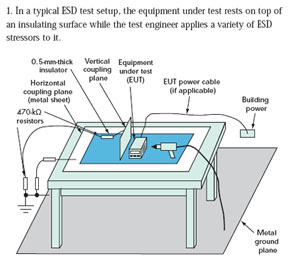
  • Vertical Coupling Planes (VCP) and Horizontal Coupling Planes (HCP) max be used for indirect application of the ESD pulse. These planes shall be constructed from the same material and thickness as the ground plane, and should be connected to the ground plane by a cable with two 470kohm resistors, one resistor at each end of the cable.
  • For tabletop equipment, a non-conductive table 0.8 meters high is placed on the ground plane. A ground plane (HCP) 1.6 meters by 0.8 meters will be put on the table, and the EUT and any cables shall be placed on an insulating support 0.5mm thick placed on top of the HCP. The HCP shall be connect to the ground reference plane with a resistive cable as in previous paragraph.


Testing for immunity to electrostatic discharge (ESD), from cell phones to computers, is usually done with the IEC 61000-4-2 standard.1 But IEC61000-4-2 is purely a systems-level test spec, not a spec for individual components. Components manufacturers are thus forced to define test plans without the guidance of a standard, and test results coming from different component manufacturers may differ considerably. So what does components testing to this standard mean? Here are the main issues to consider, particularly with respect to contact-discharge versus air-discharge results.
 

Contact-Discharge Testing


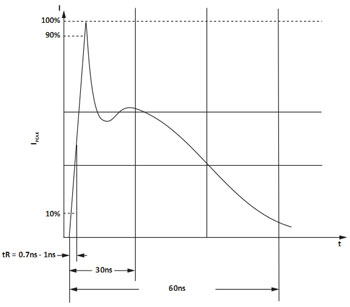
There are four recommended stress levels for contact discharge (conducting surfaces) and air discharge (insulating surfaces). Many systems are specified to pass at the highest defined levels in the standard (8 kV for contact discharge, and 15 kV for air discharge). In contact-discharge testing,2 the ESD gun is charged, the tip of the gun is placed against the object to be stressed and a relay inside the gun is closed, initiating the stress. IEC 61000-4-2 specifies a waveform for contact-level testing (Figure 1). The current waveform is characterized by an initial current spike with a rise time of 0.7 to 1.0 ns and specified currents at 30 ns and 60 ns. The current levels scale linearly with voltage from 2000 to 8000 volts. At 8000 volts, the peak current is 30 amps and the 30-ns and 60-ns current levels are 53, and 27 percent, of the peak current, respectively. Those familiar with component-level ESD testing will likely assume that contact discharge testing according to IEC 61000-4-2 is done similar to Human Body Model testing. The specified waveform is forced into one device pin, while one or more other pins are held at ground, which is the assumption made by manufacturers such as ON Semiconductor. The test that ON Semiconductor applies on its devices is to stress each pin 10 times positive and 10 times negative at each voltage. 


Figure 1: IEC 61000-4-2 contact waveform
 

In any case, when evaluating contact-discharge data for components, you need to know which pins have been stressed, which pins have been grounded during the stress, how the ground connection was made to the component being tested, and the number and polarities of the stresses to the component.


Air-Discharge Testing


In air-discharge testing, the relay in the ESD gun that initiates contact discharge remains closed throughout the test. The capacitance in the ESD gun and the tip of the ESD gun are charged simultaneously. The tip of the ESD gun is then moved toward the intended stress point until an arc forms or the gun's tip touches the system being stressed. Air-discharge testing is more challenging to adopt for component testing. Some people assume, based on Table 1, that a 15-kV air-discharge is equivalent to contact discharge testing at 8 kV. However, it is not valid to assume that a component that passes Level 4 contact-discharge tests also passes Level 4 air-discharge tests. 


 All device-level ESD standards specify current waveforms for specific voltage stress levels and thus the standard tends to ensure some level of test reproducibility. The IEC standard does not, however, specify waveforms for air discharge. The air-discharge waveforms depend on both the voltage and the geometry of the target. The IEC standard specifies a current-sensing target for verifying contact-discharge waveform parameters. The target is mounted at the center of a ground plane and has a characteristic impedance of 2 ohms (to ground). When connected to an oscilloscope with an input impedance of 50 ohms, the target produces 1 volt for each ampere of current. The discharge point is a metal disk measuring 26 mm in diameter.
 

Figures 2 and 3 display contact-discharge and air-discharge waveforms directly to the IEC target at 2, 8, and 16 kV. At 2 and 8 kV, the contact- and air-discharge waveforms are very similar, but at 16 kV the initial current spike is absent from the air-discharge waveform. For air discharge at high voltage, a very long arc forms between the gun and the target. The long arc has higher resistance and inductance than direct contact and greatly reduces the initial current spike. The nature of this arc depends on the geometry in the region of the arc. 


Figure 2: Contact discharge to IEC 61000-4-2 target


Figure 3: Air discharge to IEC 61000-4-2 target

The gun tip used for air discharge is a rounded tip and the IEC specified target has a flat surface. Electric fields are geometry dependent. Pointed tips increase the local electric field and initiate electrical breakdown earlier than flat or blunt geometries. Electrical components in state of the art packages have very small contacts, very different from the flat surface of the IEC target. Modifications to the discharge surface of the IEC target have allowed study of geometry effects.
 

The center disk of the IEC target can be removed where it screws into the main body with a 3-mm threaded rod. A series of alternative target centers were made to study the voltage properties before an HBM event.3 These targets are ideal for understanding how current waveforms depend on geometry. Electrically the targets consist of zener diodes (breakdown is 10 volts) with the anodes connected to the IEC target and the cathodes connected to various geometry pins to simulate different integrated circuit packages. The diodes simulate the ESD protection circuit of an IC or ESD protection component. Contact-discharge and air-discharge measurements were made on a variety of pin geometries. A flat surface geometry produced very similar results as those shown in Figs. 2 and 3, although the zener had been added to the current path.
 

Figures 4 and 5 show the results for a pin that's 0.4-mm in diameter (similar is size to a modern BGA solder ball). The contact-discharge measurements still look very similar to those for a contact discharge directly to the IEC target as shown in Fig. 2. For air discharge to the small pin, the suppression of the initial current spike begins at a much lower voltage. That's because the electric field around the small pin is enhanced, and the result is an electrical arc that is longer and therefore has higher resistance and inductance than for a flat surface. 
 

Figure 4: Contact discharge to a small diameter pin
 

Figure 5: Air discharge to small diameter pin
 

These measurements show there is no simple correlation between the stress level in air-discharge and contact-discharge conditions. The current waveform for contact discharge scales linearly with voltage, while air-discharge waveform shapes depend on the voltage level and the local geometry where the discharge occurs. For discharge to a flat surface at low voltages, air-discharge and contact-discharge currents are very similar.
 

At higher voltage, as the arc length for air discharge increases, the initial current peak diminishes and disappears while the rise time increases. For discharge to small geometries, such as pins on modern integrated circuit packages, the deviation between contact discharge and air discharge occurs at lower voltages. The deviation between contact and air discharge is not, however, so great as to make 8-kV Level 4 contact discharge equivalent to 15 kV Level 4 air discharge as shown in Fig. 6 for discharges to a 0.4-mm pin. Even though the peak currents for the two discharges are very similar, the total energy delivered by the 15-kV air discharge is considerably higher than from the 8-kV contact discharge. 


Figure 6: Contact discharge at 8 kV, and air discharge at 15 kV, to a 0.4-mm pin
 

Air-discharge testing is also affected by all of the features that change the properties of an arc, including humidity, atmospheric pressure, and the speed of approach. In the measurements presented here, several air-discharge pulses were taken at each voltage and a specific pulse was chosen that was considered representative for that voltage and geometry.
 

Manufacturers such as ON Semiconductor specify air-discharge ratings very conservatively. In many cases an air-discharge rating of Level 4, 15 kV, is specified based on a device's ability to pass contact discharge at a voltage level in excess of 15 kV. This approach is valid because in all cases contact discharge is a more severe stress than air discharge at the same voltage. For air-discharge testing on a component, the component is generally mounted on a board in which the pins under test are connected by short traces to flat pads to which the air discharge is applied. As shown above, air discharge to a flat surface gives a more severe stress than to a small pin. As in contact discharge, 10 stresses are performed with both positive and negative polarity. The test for contact-discharge stress can provide reproducible results, but only if the same pin combinations are used.
 

As mentioned previously, the standard gives no guidance for pin combinations because it is not intended for component-level testing. Test results for air discharge are more problematic because the nature of the stress is very sensitive to the geometry where the discharge occurs. In addition, a rating based on a contact-discharge Level of 1 to 4 will not usually be equal to the corresponding air-discharge level. An air-discharge rating based on the ability to survive an equal or greater voltage contact-discharge stress is a conservative and justifiable assumption.
 

By Robert Ashton, ON Semiconductor
Power Management DesignLine
(08/10/2008 7:30 PM EDT) 

Back To IEC Standards