RTCA/DO-160 Section 16 test procedures are used to determine whether the EUT can operate during different AC and/or DC power variations that occur during normal and emergency aircraft operation. RTCA/DO-160 Section 16 tests verify whether the equipment will negatively affect the aircraft power system that would be harmful or degrade performance in other equipment. These tests cover both susceptibility (surge, dropout, frequency transients, etc.) and harmful interference (current harmonics, re-generated energy, power factor, etc.) of the EUT.
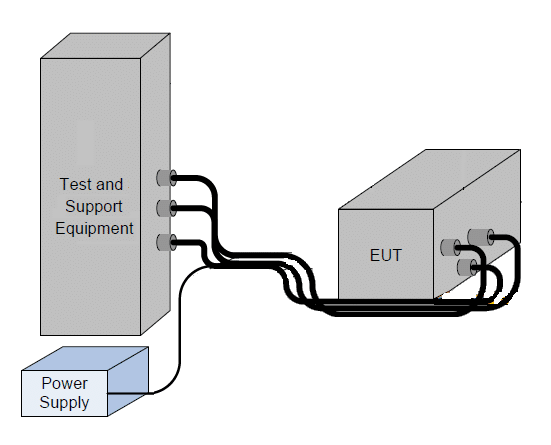
Tests:
- DC Input tests
- Steady-state over- and under-voltage conditions
- Ripple voltage
- Momentary power interruption
- Momentary sags and surges
- Exposed voltage decay time (270 V only)
- Inrush current
- AC Input tests
- Steady-state over- and under-voltage conditions
- Steady-state over- and under-frequency conditions
- Steady-state phase unbalance (three-phase power)
- Voltage and frequency modulation
- Voltage and frequency transients
- Momentary power interruption
- Momentary sags and surges
- DC offset and voltage distortion
- Harmonic current emissions
- Phase unbalance (3 phase inputs)
- DC current content
- Inrush current
- Current modulation Power factor
Equipment Categories
According to RTCA/DO-160 Section 16, there are four Equipment Categories (A, B, D, or Z) that indicate the type of power used by the equipment and the type of AC and/or DC power source with which the equipment is compatible. For AC powered equipment, an additional designator, placed in parenthesis following the Category designator, is a two-character code indicating that the equipment has been tested for use with Constant Frequency (CF), Narrow Variable Frequency (NF), or Wide Variable Frequency (WF).
Up to four additional category designators are also used to indicate testing for:
- AC current harmonics (H)
- AC current modulation (L)
- AC power factor (P)
- DC current ripple (R)
- AC or DC inrush (I)
RTCA/DO-160 provides standard procedures and environmental test criteria for testing airborne equipment for the entire spectrum of aircraft from light, general aviation aircraft and helicopters through the "jumbo jets" and SST categories of aircraft. The tests outlined in this standard are performed to meet FAA and international regulations for electrical and electronic equipment installed on commercial aircraft.
RTCA/DO-160 G is the current version of this standard. Coordinated with EUROCAE, RTCA/DO-160G and EUROCAE/ED-14G are identically worded. DO-160G is recognized by the International Organization for Standardization (ISO) as de facto international standard ISO-7137.
Products Used in Testing:
AE Techron
AE Techron 3110 Standards Waveform Generator
The AE Techron 3110 is a standards waveform generator which generates ripple wave forms of up to 300 kHz and equips technicians with a vast library of automotive and aviation test standards, holding a max capacity of 300...
AE Techron
AE Techron 3110A Standards Waveform Generator
The AE Techron 3110A Standards Waveform Generator is can generate LF wave sequence with a bandwidth of DC to 1 MHz. This 3110A model reduces test time for repetitive test sequences, featuring a rise time of under 1 µs and...
AE Techron
AE Techron 7794 4-Quadrant Power Amplifier
The AE Techron 7794 4-Quadrant Power Amplifier is a powerful four-quadrant amplifier that offers up to 200 Ap power, DC - 100 kHz bandwidth, and controlled-current or controlled-voltage modes of operation. The AE Techron...
AE Techron
AE Techron 9100 Amplifier Series
The AE Techron 9100 Amplifier Series is made up of three units of wide-bandwidth, high-power amplifiers, including the 9105, the 9110, and the 9115. Each unit has multiple operating modes and a typical power factor of 0.98...
California Instruments
California Instruments Tahoe | TA0045A1 Power Supply | 45 kVA
The California Instruments TA0045A1 AC Power Supply features an AC voltage range of 0 to 333 Vrms L-N (0-440 Vrms L-N Optional). The Tahoe Series has a separate terminal block design for single-phase and 3-phase outputs. With a...
Pacific Power Source
Pacific Power 3150AFX AC & DC Programmable Power Source
The Pacific Power 3150AFX AC and DC Programmable Power Source has significantly less size and weight, which is a breakthrough in solid state power conversion. The 3150AFX generates 15,000 VA of output power while being housed...